
How 150K+ filers opted into AI inside their tax return
TaxAct features SmartFile AI, an in-product assistant designed to help you navigate your tax return. The tool answers questions, explains upcoming steps, and analyzes your screen in real-time, all without ever training on your personal or sensitive data.
Challenge
Filing is high stakes, especially for people with 1099 income, deductions, or multi-state returns. When users get stuck, they rarely fix it inside the product. They leave to search, ask a CPA, or abandon the return.
AI could help in those moments, but tax is not a place for novelty. Accuracy, trust, and compliance mattered more than speed.
The challenge was simple to say and hard to design. Help people move forward without breaking trust.
I led the design of SmartFile AI for TaxAct, tested six interaction models during peak filing season, then shaped how the winning model worked on every screen, including the phones most people file on.
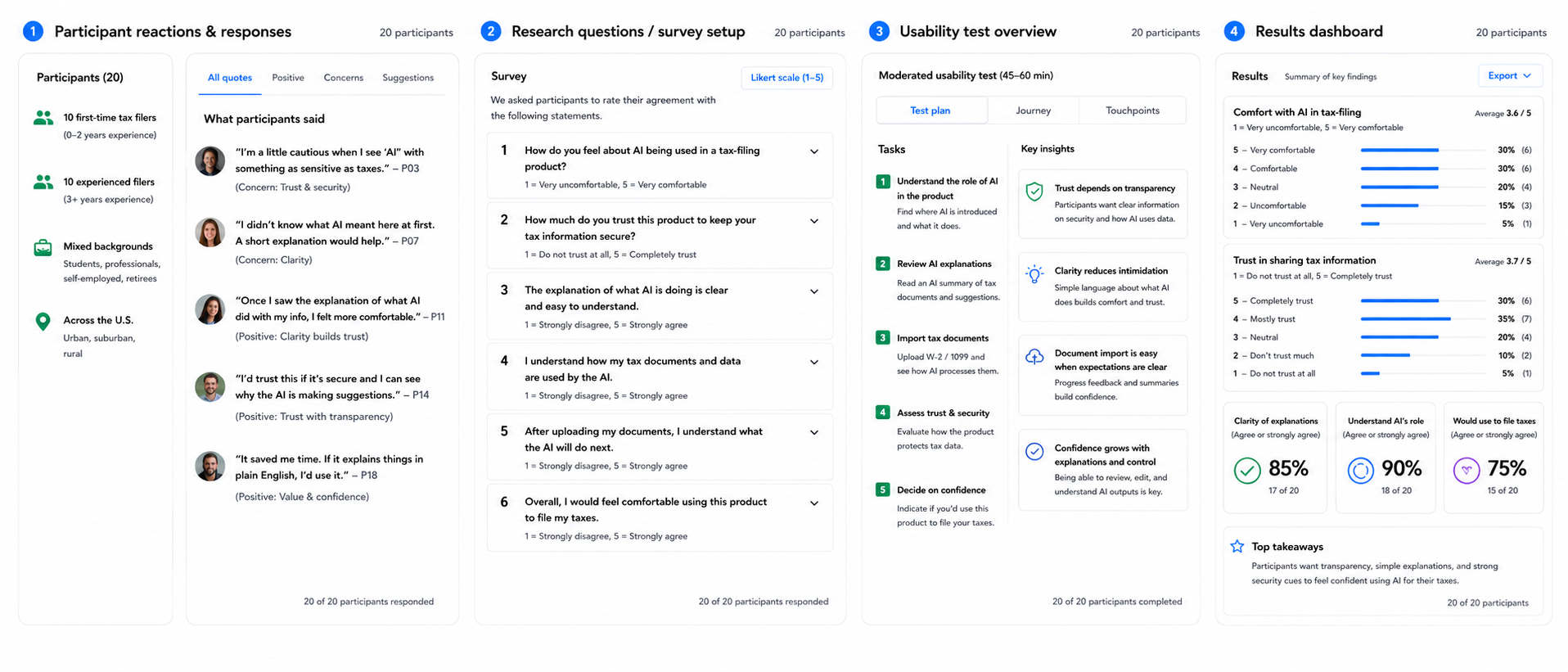
We ran early moderated usability testing with 20 participants to understand reactions to AI in a tax-filing experience.
• Whether the word “AI” felt confusing or intimidating
• Whether people would trust the product with their tax information
• Whether the experience clearly explained what AI was doing
These learnings were validated before moving into later A/B testing.
20 moderated participants
US residents, ages 22–65
Six bets, one filing season
Instead of betting on one solution, I led the design of six interaction models tested in production during peak season.
This round was about the experience itself: what kind of help belongs in a tax return. Is it support, document handling, or a guide?.
Each variant explored a different mix of AI visibility, consent, capability, and entry point. We started at 1% of traffic and scaled to full exposure by mid April. The goal was never clicks. It was finding the model that helped people stay in the filing flow and make progress.
6
variants running in parallel
1%
starting traffic exposure
mid April
scaled to full exposure
The model that won
Document-aware assistance, in context
SmartFile lives in an optional bubble in the corner. Tap it and three actions fan out: ask a question, add a document, or find a section. It stays out of the way until you want it, so help never competes with the return.
Consent first. A plain note on what the AI does and does not do, before it touches the return.
Document-aware prefill. Upload a W-2, SmartFile reads it, shows what it found, then fills the fields after you agree.
Review before continuing. Filled fields stay editable. Nothing is committed without a look.
A path back. When SmartFile routes you to a section, it keeps a visible way back to where you were filing.
Suggested prompts. Quick starts so no one faces an empty box.
On desktop these actions sit in tabs beside the chat. On a phone, where most people file, the same actions collapse into the bubble: fewer, cleaner clicks and nothing crowding the screen.
Strategy
I treated the season like a live experiment. Six variants ran in parallel. Weak ideas were removed quickly. Stronger ones were expanded.
The tooltip entry point had low engagement and was removed within the first day. We also rejected a full chat-first destination because it pulled users away from the return.
The strongest model combined chat, document upload, and AI-assisted prefill. It gave users help in context instead of sending them somewhere else. I shaped the mobile version so the same help fit the phone, where most returns get filed.
The winning model became the foundation for TY26, with SmartFile support built into the filing flow rather than sitting beside it.
The winning model became the foundation for TY26.
After the season, the next question was not whether users would engage with AI. They had. The question was where the AI work should live.
The side chat helped users ask questions and upload documents, but filing is more than a chat experience. Users still needed one workflow where SmartFile could guide, prefill, explain, and surface what needed attention directly inside the return.
For TY26, we continued moving toward a more unified filing experience: SmartFile support embedded into the product, not sitting beside it.

Results
The variant I drove outperformed every other model across engagement signals, including session depth and interaction frequency.
155,235 consents across the season
111,960 sessions during the launch window
24,000 sessions on Tax Day
66.7% deep engagement, 2+ turns
49.7% at 3+ turns
14.1% of sessions used document upload
It was the clearest signal that users would use AI inside the filing flow when it helped them complete the task in context.
“I hate ai, but darn it, yours was helpful.”
TaxAct user, 5-star review, Trustpilot